
In most houses that fail their airtightness test, it is not one big mistake that causes the failure, but a few details that can no longer be seen once the finishes are in place. Here are the five leaks we find most often during our tests in the Bas-Rhin, ranked from the most hidden to the most obvious.
1. Soil stacks and floor penetrations
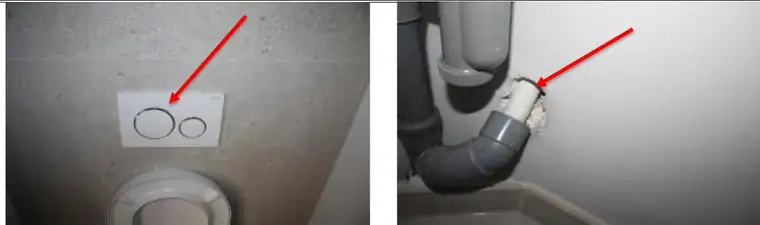
Leaks found during a test: around the flush plate of a wall-hung WC and along a drainage stack.
This is the hidden defect par excellence. Drainage stacks pass through the floors and often end up inside the frame of wall-hung toilets. If the penetration is not sealed before the boxing-in is fitted, air flows freely along the pipe and comes out under the toilet and around the flush plate. At test time, the leak is trapped behind the tiles: impossible to fix without dismantling.
The same care is needed for stove or chimney flues, ventilation outlets and all roof penetrations: each one must receive a suitable sleeve or seal before being closed in.
2. The junction between walls and floor
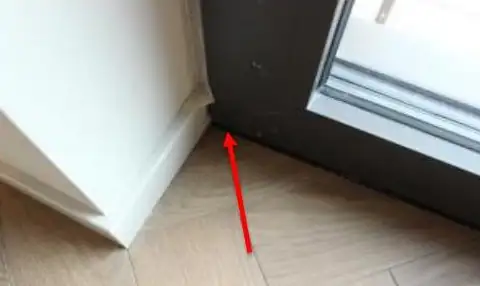
Leak found at the foot of a wall, where the skirting board, the floor and the frame of a French window meet.
At the foot of the walls, where they meet the slab or floor, leaks are rarely localised: they are diffuse, along the whole length of the walls. They are the hardest to deal with once the house is finished, because there is no single hole to plug but metres of junction to rework, often behind the skirting boards or under the floor covering. The right time to treat them is before the linings and screeds, during an intermediate test.
3. Services behind the plasterboard
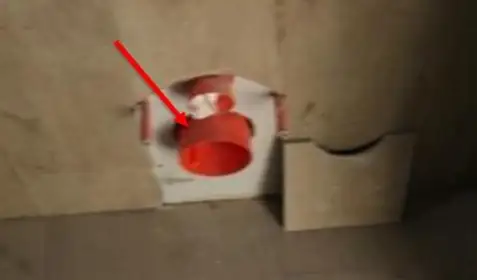
Non-airtight flush-mounted electrical box: air passes through the cable entries.
Behind plasterboard, mistakes are unforgiving. A plasterboard sheet is not an airtight barrier: what matters is what lies behind it. On a brick or concrete-block wall, a render or continuous treatment of the masonry is needed before lining. Without it, air passes through the block joints and comes out at sockets, switches and skirting boards.
Flush-mounted electrical boxes are a classic: a standard box on an external wall or in a ceiling below the loft lets air in through its cable entries. Airtight boxes exist and should be specified from the electrical package onwards.
4. Windows and doors: adjustment and frame-to-wall junctions
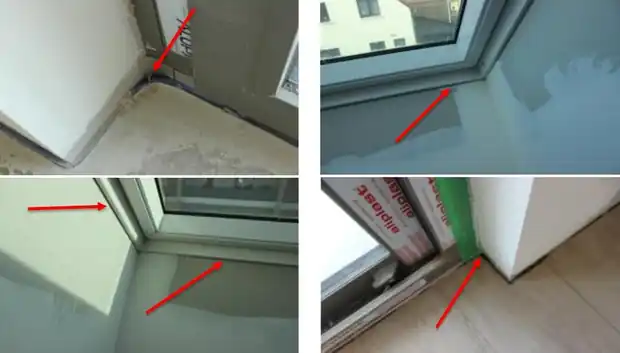
Leaks found at frame-to-wall junctions and at the adjustment of opening sashes.
A quality window can leak if it is poorly adjusted or poorly connected to the wall. We always check two points:
- Sash adjustment: a sash that does not compress its seals properly lets air in along its full height. A few minutes of adjustment by the joiner is often enough.
- The frame-to-wall junction: the joint between the window frame and the masonry or timber frame must be treated with a membrane, adhesive tape or suitable seal, and not just with expanding foam.
French window thresholds and roller-shutter boxes are also points to watch.
5. The loft hatch
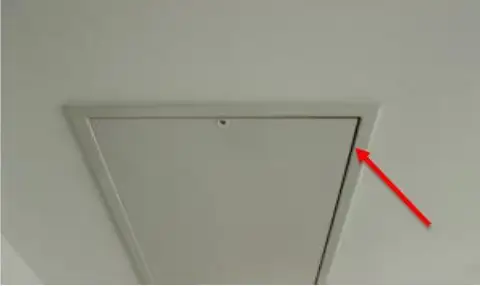
Loft hatch without a perimeter seal: air passes all the way round.
It seems obvious, yet it is a leak we come across very often. The loft hatch, or the folding loft ladder, opens directly onto an unheated space. It must be fitted with a perimeter seal and close by compressing it. A simple hatch resting on its frame is enough to lose precious hundredths on the result.
How to avoid these unpleasant surprises
These five leaks have one thing in common: they are easy to fix while still visible, and very costly once hidden. That is the whole point of the intermediate test, carried out when the building is weathertight, before the linings go up. During the test, we depressurise the house and go through each room with you to locate the leaks, by hand or with our detection tools.
Exp'Air 67 has been carrying out airtightness tests for more than 15 years in the Bas-Rhin and across the Grand Est. We hold Qualibat 8711 for building envelopes and 8721 for ductwork.
Read also: Price of an RE2020 airtightness test in Alsace: what affects the cost