
For a new building subject to RE2020, the declaration certifying completion and compliance of the works (DAACT) must be accompanied by a certificate that the environmental regulations have been taken into account. Without it, the file is incomplete. And it is often at this point, at the very end of the project, that people discover documents are missing or do not match what was built.
Who issues the completion certificate?
Contrary to a common belief, it is not the thermal engineering firm that issues the completion certificate. It must be issued by an authorised professional who was not involved in the design. Exp'Air 67 is authorised to issue it, in the same way as a technical inspection firm.
We carry out the airtightness test, then we issue the certificate itself.
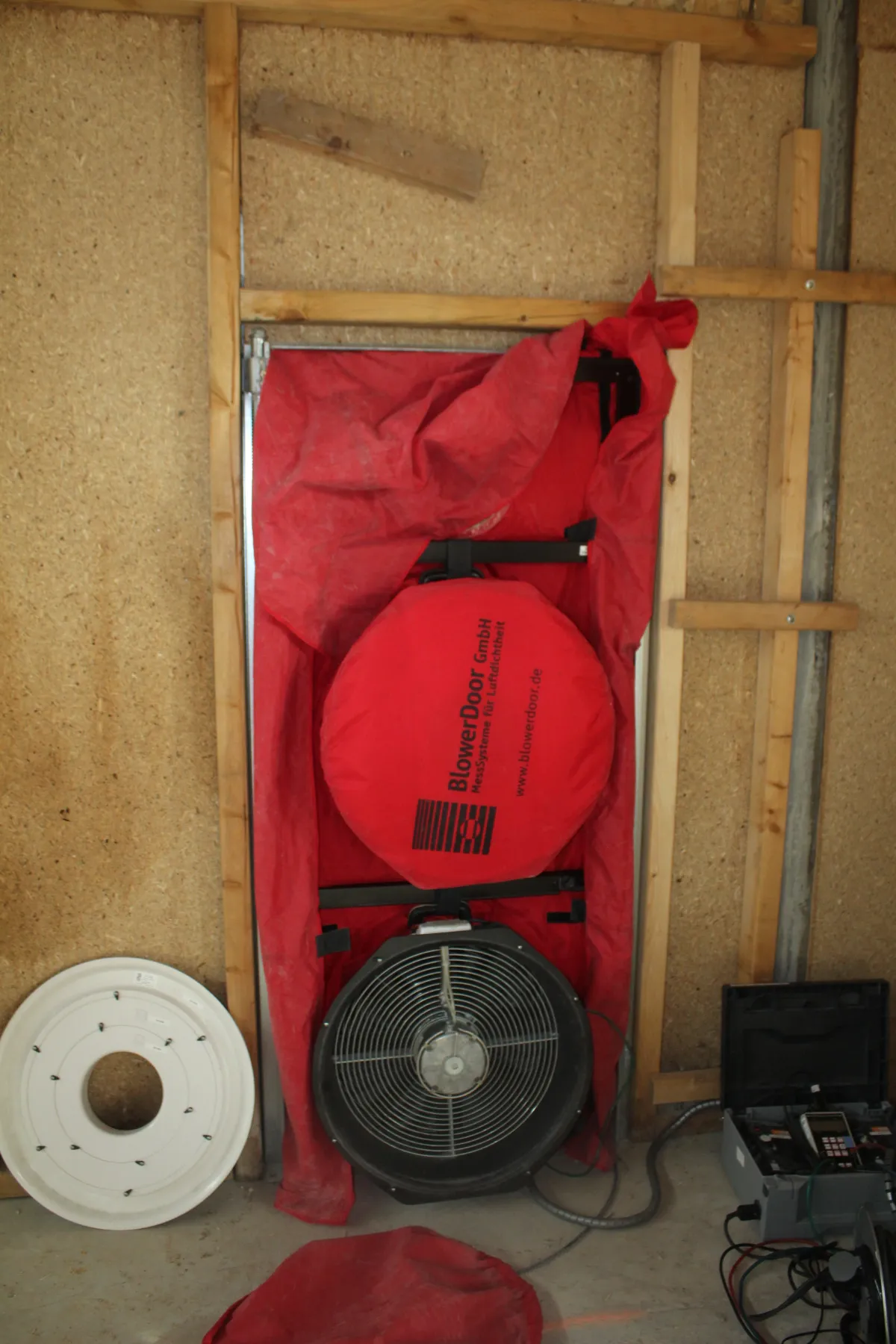
Blower door installed for the final airtightness test, the first step before the RE2020 certificate.
What we need
- The complete RSEE file in ZIP format, provided by the thermal engineering firm. This file contains the regulatory study of the building. A simple PDF summary is not enough.
- A validated airtightness test, meeting the value used in the study.
- A validated ventilation verification protocol (airflows, pressures, ductwork airtightness as applicable).
Once these three elements are gathered and consistent, we upload the file to the official government platform and issue the certificate to be attached to the DAACT.
The most common sticking point: an RSEE that no longer matches the building
The RSEE is drawn up at design stage. Between the building permit and handover, a lot can change: one insulation material replaced by another, a heat pump from a different brand, single-flow ventilation instead of heat-recovery ventilation, different windows…
Yet the completion certificate checks that what was built matches what was calculated. If the materials and equipment actually installed do not match the study, the RSEE must be updated by the engineering firm before the certificate can be issued.
To do this, it is up to the architect or project manager to send the engineering firm the list of materials and equipment actually installed: insulation, windows, heating, hot water, ventilation… When this information has not been passed on during the works, the update is done in a rush and delays the DAACT.
How to avoid delays
- Inform the engineering firm of every change of material or equipment as soon as it is decided, not at the end of the works.
- Ask for the updated RSEE in ZIP format before the date of the final test.
- Plan an intermediate test to secure the airtightness result, and an intermediate ductwork test when the study targets airtightness class B or C.
- Entrust the test and the certificate to the same operator: a single point of contact and fewer documents passed between different parties.
Our support
Exp'Air 67 works throughout the Bas-Rhin and the Grand Est on single-family houses, apartment buildings and commercial buildings. We carry out the airtightness test (Qualibat 8711) and ductwork airtightness testing (Qualibat 8721), and we issue the RE2020 completion certificate.